Wednesday, February 10, 2010

Private Jets and Private Lives

ed young It’s been a rough week for the folks at Fellowship Church in Dallas.  One of the local television stations produced an eight minute long “expose” of Pastor Ed Young, raising questions about his financial relationship with the church.  They seem most excited about a supposed “secret” Fellowship corporate jet.

Ed and the Fellowship board responded during services over the weekend.  The remaining question is how will the affect Fellowship going forward. 

I’m not going to bother to link to the TV piece itself.  You can find it, and Young’s response easily enough if you’re interested. 

I do have a few thoughts and reactions.

First, the story itself was pretty weak.  It rested on a single interview with an anonymous person who clearly doesn't like Fellowship Church.  

It included inflammatory language, and unsubstantiated conclusions and statements, including stating that attendance has declined at Fellowship.  I haven't been there in about six months, but the last time I did make it to Dallas, the auditorium was full on both Saturday night and Sunday morning.

Particularly outrageous was a statement that Young is perhaps “violating the covenant of honesty with his congregation.”  That’s about as close to libel per se as I think you can get.  To call a doctor a quack… a lawyer a shyster… or a pastor dishonest?  I’m going to guess the TV station’s lawyers didn’t approve that statement ahead of time!

The interview with an SMU “expert” was interesting.  He stated that the church should own the intellectual property created by the Senior Pastor.  He called it outrageous that the Pastor would want to control that.  

Well, he may not like it, but it is pretty common and accepted practice.  Sermons become books.  Do you think Max Lucado has ever used sermons to flesh out an idea that eventually became a book?  Do you suppose Rick Warren used the phrase 'purpose driven' in a sermon before the book came out?

Who owns the rights to that intellectual property is more correctly part of a discussion of employment terms between the church and the Pastor. 

It's the same with questions of compensation.  You may not like the fact that a Pastor makes a lot of money and can afford a big house. I, personally, try to be pretty careful about attaching motivation to actions I observe.   Discerning fruit is one thing.  But there's also that whole judging thing, too.  Be careful.

The only REAL question raised in the entire story was that of the airplane.  That was addressed by Ed and two of the members of his Board of Directors at Fellowship over the weekend.  Sort of.

They indicated, but did not state directly that the plane is leased. 

OK. 

They said that the board approved of the use of Ed's use of private aircraft, for much the same reason that corporate CEO's make use of them.  Their time is quite valuable.  To leverage them, and to take care of their health and family lives, a judgment is made that the expense of corporate aircraft is justified.

Again... a decision for the Fellowship BOD to take carefully.

My counsel for Fellowship and Ed Young?   I have no idea what is actually happening behind the scenes.  I don't know if there is actually a problem or not.   Based on what I've seen and read this was a bit of a hatchet job by the television station.

I do know this.  For pastors, a private life is a dicey concept.  Like public officials, they have chosen a position where conduct in private has far greater impact that for the average person.

It is time for a season of radical transparency for Fellowship.  Do not allow this wound to fester.  Open books.  Open meetings.  Open minutes.   Over communicate and over disclose.  There should be virtually nothing under wraps.  If a reporter wants to know how much you make, get in the Hummer, and drive over and meet with them. 

Not at least meeting with the reporter in this case was a mistake.  It carries the appearance of impropriety, and not a little bit of fear of disclosure.   That is like chumming the water for a reporter.  On the other hand, sitting down with them, off camera at least to start with, and talking about all of their questions will disarm all but the most rabid of reporters.

Radical transparency and telling the truth, even when it might not be comfortable is the only response going forward that will keep this from becoming a millstone around the neck of the church.

Tuesday, February 09, 2010

Will Churches be Excluded from Wireless Interference Protection Plans?

Shure Wireless In the wake of the recent FCC ruling that set a final date for the retirement of wireless microphones in the 700 MHz band, there’s word that churches may be excluded from the new geo-location database that will provide important protection from interference with your wireless mics.

Chris Lyons with Shure, and Doug Gould of Worship MD (formerly with Shure, too!) along with many others are working hard to get the word out on what could be a huge issue for churches. It’s another part of the complex 700 MHz, digital TV transition, white spaces issue that have been causing confusion for wireless users for the past few years.

The FCC is considering a change in licensing rules, for wireless microphone, in-ear monitors, wireless com and similar equipment operating in the television broadcast band.

Until now, only a select few, like broadcasters, and movie and TV producers could actually license this equipment. All other users, including churches, schools, theaters and other users were operating without a license. The FCC has been aware of this for years, and operation of these devices is permitted with or without a license.

However, development and testing of a new generation of portable devices and fixed location services has begun. Look forward to a lot of cool new connected toys. But, they will be operating in the same TV bands that wireless mics use.

To protect wireless mic, monitor and com users, the FCC is working to develop a geo-location database that will allow licensed wireless users to register their systems. These new TV band devices will check that database to avoid licensed wireless users. It’s an important protection to avoid having someone with a cool new connected handheld device stepping all over your wireless mic transmissions in the middle of a show.

The question is whether churches will be among those who can obtain licenses, and register in the database.

“The FCC believes that not everyone needs protection from interference, and that protecting everyone would make too much spectrum off-limits to new internet-enabled ‘white space’ devices.,” said Lyons. “They are seeking some way of classifying wireless mic users so that they can easily determine whether they should or should not be eligible for license, whether that is based on the type of facility (church, school, theater), type of activity (broadcasting, recording, live performance), number of seats, or whatever.”

And, if churches are not on that list, that could potentially leave churches wide open to intermittent and continuous interference in their systems.

So, what can you do about it?

The FCC is accepting comments on who should be allowed to get licenses until February 22nd. It is critical that they hear, loud and clear from churches about how important it is that they be allowed to register.

For guidelines on how you can submit comments on this issue, send an email message to wirelessmicrophones@shure.com. You will receive a reply message with details on information to be included in your comments and how to file them with the FCC.

In your comments, be sure to include how many systems you use, what kind of services and productions you do, and describe the impact that losing reliable wireless would have on your services.

I’ll be sending my comments later today. I hope you will, too.

HOUSEKEEPING NOTE: If you think you’re seeing double on this post, you’re correct. I also write at ChurchTechMatters.com, and it’s always been my policy not to duplicate posts between the two. I want you to read both blogs, and hope what I write at CTM has some real value. I’m making an exception with this post, because the issue is time sensitive and critical.

Monday, February 08, 2010

The End is Near, for 700 MHz Wireless

End is Near So maybe it's not really as dramatic as all that, but as far as wireless microphone use in the so-called 700 MHz band, it is now official.

As of June 12, and possibly earlier in some cases, use of wireless mics transmitting between 695 and 806 MHz is officially illegal. The final rule was issued on January 15.

This wireless spectrum has been reallocated for use by public safety agencies, and by wireless service providers. 

As we've said before, the FCC won't have a squad of 'wireless cops' cruising the streets on Sunday morning, looking for violations.  What is clear, though, is that the wireless companies who have spent BILLIONS of dollars to buy up spectrum will be watching.  One of those providers began sending letters to higher profile wireless users last year, warning them that they would be watching for any infractions. 

So, it's time to stop using the systems.  It will be against the law to fire them up after the deadline. Thankfully, church techs now have a firm date to refer to when discussing this with church boards.  It would have been nice if they'd announced the date a bit earlier... say before budgets for 2010 were set, but they didn't. 

Beyond the fact that it's wrong, there is actually an element of danger in continuing to use the systems.  As the FCC order itself points out, your system could interfere with a public safety radio system.  Is it highly likely?  Probably not.  But it is possible, and that would be bad.

So, where to go from here? More on that over at Church Tech Matters this morning!


Tuesday, February 02, 2010

What’s to be Learned from a Murder

rt So, for the last month or so, I’ve been up to my ears in managing media for a very high profile murder trial going on here in Wichita.  I was working for the courts and the trial was big, big news. 

This is not the place to discuss the merits of the case, or the issue itself, but there were a few lessons learned that I thought were worth passing on.

As you can imagine, there was crazy media interest in this case.  More than 150 credentialed reporters, from about two dozen organizations covered the trial.  Enough satellite trucks that we had to close a lane of traffic on Main Street to park them all.

So, what are the take-aways with regard to media relations?

First, if you aren’t tracking social media,you’re entirely out of the loop.  There were thousands of tweets and other social media posts regarding the trial.  I live in the connected social media world, and I was still shocked by the sheer volume. 

I was also saddened, and shocked by the gross inaccuracies that spread like wildfire via Twitter.   Most were a result of laziness and ignorance, people repeating and retweeting, rather than checking things out.  Some were intentional, leveraging repeating and retweeting to push an agenda. 

Most disturbing were traditional media and ‘experts’ who didn’t do their homework, and spread misinformation via blogs and tweets.

Beyond social media, it’s clear that the definition of ‘media’ has and is changing rapidly.  Because of the nature of this trial, we had a lot of folks claiming to be media who clearly weren’t.  Many were just partisan players on one side of the issue or the other who knew they wouldn’t likely be able to get a seat in the courtroom (due to space limitations) and wanted a seat, or really wanted access to the media themselves.  Those were fairly easy to weed out.  

Harder was dealing with freelancers and those working for web only, or non-traditional but legitimate media outlets. Coming up with a fair and at least relatively objective way to identify who are ‘real media’ is going to become more and more difficult over time.

So what does that mean.  Pretty simple.  Get some help.

Managing media for a major event being covered by national and network level media is not an activity for an amateur or even the average PR person. There are tough calls to make, major egos to manage, and you have to be willing to make a few people more than a little bit angry.  Trying to do it yourself would be a bit like watching monkeys play with guns

It’s fun at first, but in the end, somebody’s gonna get hurt.

Monday, February 01, 2010

So, Where Have I Been?

workroom2 Sorry for the long absence!   Maybe we should cue the the theme from  “Welcome Back Kotter!” I  have been a busy guy since right after Christmas.  

Along with all of the normal stuff, I have just wrapped up a huge assignment, managing the media relations for the local district courts in a “major murder case” here in Wichita. 

There’s absolutely no need to discuss the merits of the case here, but from a communications management standpoint, it was pretty interesting. 

Local media, and national media from coast to coast covered the trial start to finish.  In Session Television, formerly known as Court TV televised it live.  Networks in and out, with the Haiti earthquake and the State of the Union address impacting who would come to Wichita to cover the trial.

Lots of folks who were clearly not legitimate media who wanted access and media privileges.  Lots of freelancers working for mainstream outlets, web only outlets, or non-traditional outlets.  More than 150 media people from about two Lots of tough calls to be made within a pretty high pressure environment.

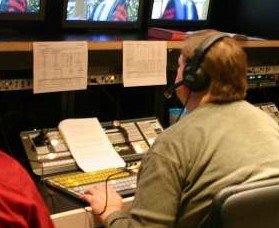
The photo above is the media workroom, actually a courtroom taken over by reporters, most of whom couldn’t get a seat in the courtroom itself.   What you can’t see is the seating all around the edges of the room, full of print and radio reporters as well.

All in all, a big job, but a very rewarding assignment.  I am, however, glad to be back at my desk for the first day in more than a month.   In the next few days, I’ll share a few lessons learned, and things already understood that were reinforced.

Now, back to our regular programming.

Wednesday, December 02, 2009

A Big Number… and a Big Challenge

Think you know where the information revolution is headed?

Think again.

HT to Jon Edmiston!

Monday, November 23, 2009

Copyright Confusion and Simple Solutions

Copyright sign


One of the most confusing topics to be discussed in church has nothing to do with the Trinity, or pre vs. post-millennialism, or even anything that remotely resembles theology.

It’s Copyright.

Years ago, the debate was over whether it was OK to copy music for the choir.  (It’s not.)   In the late 90’s the question of projecting lyrics was the hot button.  Today, it’s webcasting and downloading that cause the confusion.

It’s a confusing topic, but the underlying question is pretty simple, and one worth discussing.  I believe every church should have a policy, whether formal or informal, indicating their organizational intent to honor the spirit and letter of the law when it comes to copyright.

Why?

It is simply the right thing to do.  It honors artists.  It may not seem like a big deal to copy a CD for your worship team, but it is.  I posted a while back about musician and recording artist Dennis Jernigan, who put it this way.

“I hope you understand how hurtful and harmful that is for me and my family. If I can even stammer a reply to these people offering insights into how making unauthorized copies of my CDs affects my ability to provide for my family, the retort is too often, ‘God gave you the music freely. You should be willing to give it away freely.’”

So, if we can all agree that honoring copyright is the right thing to do, how do we go about it?

Fortunately there are some easily accessible, affordable, and easy to use tools that make the process a lot simpler!

Read more on that at Church Tech Matters this morning!